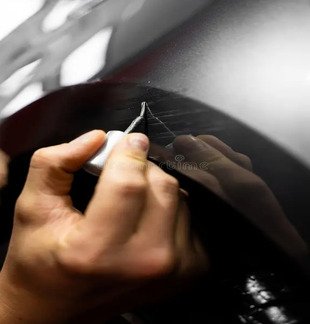
All substrates must be stable, level, mature, uniform, durable, dry, free of loose parts, and must not show a tendency for shrinkage, rising damp, or be subject to negative hydrostatic pressure. Remove loose/flaky sections, dirt, oils, and dust. Regarding the quality of concrete as a substrate, it should have a minimum tensile strength of 1.0 N/mm2 and a minimum compressive strength of 25 MPa, and contaminants must be removed by scraping, sandblasting, or other mechanical means. After this, the surface must be cleaned of dust using a high-suction vacuum. If the substrates are uneven or have cracks, repairs are required. Repairs should be carried out using suitable materials such as SUPERFIX 30, SUPERFIX 50, BETOFIX B70, etc. BAU-RESINA has the ability to bridge cracks up to 0.2mm wide originating from the substrate. Surfaces must be properly prepared by applying a coat of BAULAT, SUPERLAT LATEX, or SUPERGRIP primer, diluted with water depending on the type of substrate, to improve adhesion and reduce absorbency. SUPERGRIP is suitable for low-porosity surfaces (old tiles, marble, etc.). BAULAT or SUPERLAT LATEX are suitable for medium and high-porosity surfaces.
The material is prepared in a container by first pouring approximately ¾ of the required amount of water and gradually adding the contents of the bag while mixing using a low-speed electric mixer. Then, add water until a homogeneous mixture with the desired workability is achieved: approximately 7.5 liters per 23kg bag. To enhance adhesion and elasticity, you can use Component B (resin) instead of water, which is packaged in containers with a pre-determined mixing ratio. The mixing ratio of Component B is not mandatory. You can add a smaller amount for a more thixotropic composition, depending on the application.
*The addition of excessive water can lead to a reduction in the strength of the mortar. Regular stirring is recommended. After mixing, it is ready for use; do not add any other additives (cement, aggregates, etc.) to the BAU-RESINA system.
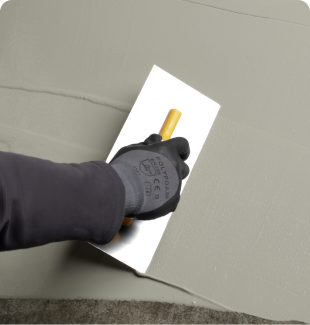
Apply the mixture to the substrate using a flat metal trowel, pressing it into the surface. Apply the second coat when the first has dried. If there is a risk of substrate cracking, apply a universal layer of 4x4, 160gr fiberglass mesh embedded in the first layer of mortar. Then, smooth the surface with the metal trowel for its final leveling. After a few minutes, when the material begins to harden, you can press with the trowel for a smooth surface. You can moisten the trowel with water before the second "pressing" to create shadows or create a different texture depending on how the final layer is pressed. The surface can be sanded before applying the varnishes, depending on the aesthetic result we wish to achieve.
After its application, BAU-RESINA must be cured with special treatment, especially when the application takes place in high ambient temperature or when there is high airflow. Excessively rapid evaporation of the mixture's water can lead to a significant reduction in the strength and hardness of the final surface or even create cracks on the surface due to the material's plastic shrinkage. To avoid the above phenomenon, spray the surface with water 6-12 hours after application and repeat the process every 4-5 hours for 2-4 days. Alternatively, 6-10 hours after the material's application, apply the first coat of water-based BAUSIL varnish. Apply at least 2 coats, each coat before the previous one dries completely, and not less than 200gr/m2 total consumption, taking care not to leave any spots on the surface without varnish. For floors and surfaces with standing water, also apply an additional layer with the polyurethane varnish HARDOX PU. HARDOX PU should be applied after a few days (at least 2-3).
*Avoid application on days with temperatures above 30°C and below 5°C. Immediately after use, clean the application tools with water.
SOURCE: BAUER